
The District 30 race in Queens is heating up, reflecting the area’s complex political landscape. Incumbent Councilmember Bob Holden, a Democrat known for often siding with Republicans, has long matched his district’s unique voting patterns—recently favoring Republican candidates despite a 3-to-1 Democrat-to-Republican population ratio. Now, three Democrats and one Republican are vying to replace Holden.
The Democratic contenders include Dermot Smyth, a well-funded teacher’s union operative backed by the Queens County Democratic Party; Paul Pogozelski, a local hockey league organizer; and Phil Wong, Holden’s endorsed candidate. Alicia Vaichunas, Holden’s Deputy Chief of Staff, is the sole Republican candidate and faces no challengers.
Read More: Top Queens Political Figures Back Candidates in District 21 Race
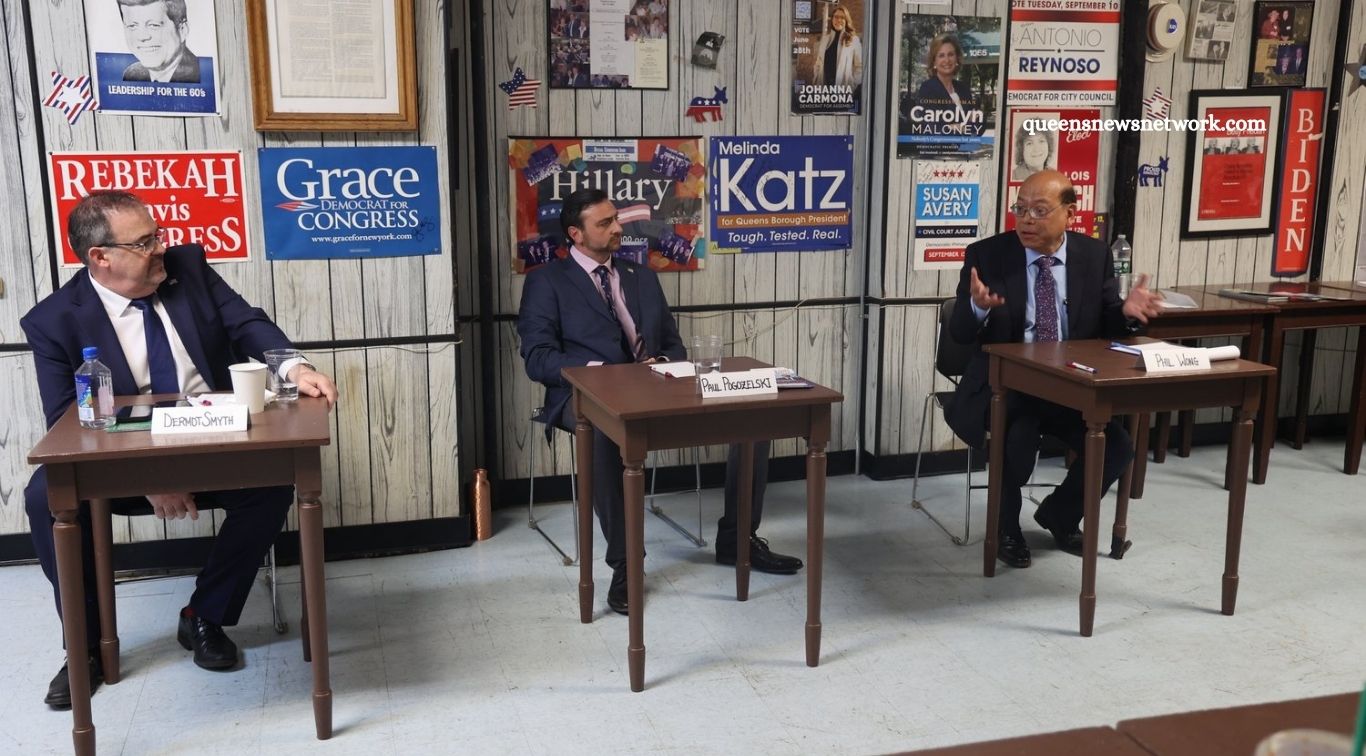
At a recent Ridgewood Democratic Club debate, the three Democrats clashed fiercely, exchanging accusations and criticisms alongside their campaign pitches. The tense tone was evident early when former candidate Michael Lopez, recently removed from the ballot, addressed the crowd, highlighting ongoing disputes with the candidates.
Smyth, leading in fundraising and endorsements, urged voters to scrutinize endorsements—criticizing Wong’s support from Republican mayoral hopeful Curtis Sliwa and Pogozelski’s lack of community backing. Wong embraced the cross-party endorsement, emphasizing a focus on district results over party labels. Pogozelski countered Smyth’s out-of-district fundraising, pointing out that 65% of Smyth’s funds come from outside District 30, though Smyth claimed he didn’t want to burden local residents financially.
Smyth’s campaign enjoys strong backing from citywide Democrats, including councilmembers from Manhattan and New York City’s Democratic leadership. Yet, during the debate, Smyth frequently attacked his rivals, even losing time for sarcastic remarks.
Pogozelski, a recent district resident and former Republican voter with limited local election participation, was accused by Smyth of self-interest. Pogozelski defended himself, blaming career politicians like Smyth for his previous political disengagement and saying his campaign aims to challenge the status quo.
Focusing on the issues
Candidates largely shared moderate views on key district issues, differing only on a few policies. All agreed the city should hire more police officers and impose stricter regulations on e-bikes—positions previously supported by Councilmember Holden.
Pogozelski, the race’s most independent voice, stood out by advocating for police officers to live locally and supporting congestion pricing, unlike his rivals.
Immigration sparked the biggest divide. Wong, an immigrant from Hong Kong, criticized the city for using local resources to address what he called a federal immigration issue. “City funds shouldn’t solve federal problems,” he argued.
Smyth, born in the U.S. but raised in Ireland, emphasized the need to support immigrants living on society’s margins. “The problem arises because we don’t provide pathways for immigrants to gain citizenship and work legally,” he said.
Where the race stands
The impact of candidates’ attacks and debate positions on their election chances remains uncertain. Democratic consultant Evan Stavisky noted very few undecided voters entered the debate, suggesting its influence may be limited.
Stavisky sees the heated debate as a reflection of a competitive race, not its cause. He emphasized that in a Democratic primary, aligning with Republicans rarely leads to success—regardless of incumbent Bob Holden’s local popularity.
Holden lost the 2017 Democratic primary but won the general election as a Republican, highlighting the district’s complex dynamics. Stavisky explained that Democratic primary voters are typically motivated to oppose the Republican agenda, making Smyth’s criticism of Pogozelski and Wong as “Republican-leaning” a potentially effective strategy.
“We live in polarizing times,” Stavisky said. “Those who ignore history risk repeating it.”
After initial reports claimed Pogozelski supported placing Rikers Island into receivership, he clarified he misheard the question. He supports allowing ICE agents on Rikers but opposes receivership if ordered by a federal judge.
Frequently Asked Questions
What triggered the recent tension in the District 30 race?
The race intensified following a combative debate where candidates exchanged sharp criticisms and highlighted key policy differences.
Who are the main candidates competing in District 30?
The race includes three Democratic candidates—Dermot Smyth, Paul Pogozelski, and Phil Wong—and one Republican candidate, Alicia Vaichunas.
What are the main issues debated by the District 30 candidates?
Candidates focused on police hiring, e-bike regulation, congestion pricing, and immigration policies, with some differences in their stances.
How did the candidates’ views on immigration differ?
Wong criticized the city for using local funds on federal immigration problems, Smyth emphasized supporting immigrants with legal pathways, and Pogozelski’s views were less highlighted.
What impact did the debate have on the candidates’ campaigns?
The debate intensified the race’s competitiveness and helped clarify policy differences, though its effect on undecided voters remains uncertain.
Why is the District 30 race particularly competitive?
The district’s unique political makeup—with a Democrat majority but a history of Republican support—creates a complex electoral landscape.
Conclusion
The District 30 race remains highly competitive as candidates sharpen their focus on key local issues and seek to distinguish themselves ahead of the primary. With shared moderate views but clear differences on immigration and policing, the outcome will hinge on which candidate best connects with voters’ priorities. As the campaign heats up, residents can expect continued spirited debates and a closer look at how each contender plans to address the district’s unique challenges.