
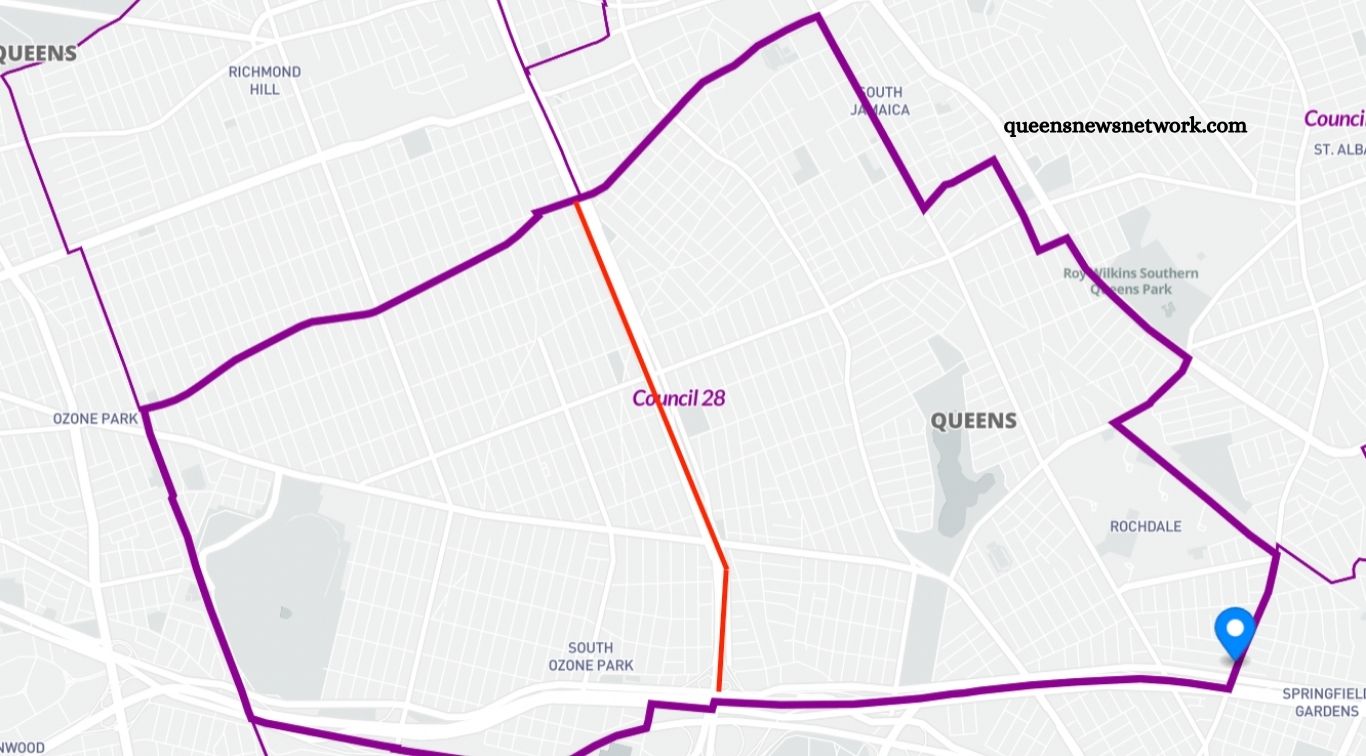
The Van Wyck Expressway, a notorious north-south highway slicing through Queens, New York, is more than just a traffic headache—it’s the geographic and cultural dividing line shaping one of the borough’s most contested City Council races in District 28. This expressway literally splits the district into two distinct halves, each with its own unique political, racial, and social makeup, which now stands at the center of a fierce campaign to succeed term-limited Council Speaker Adrienne Adams.
A District Divided: Geography and Demographics
District 28, often called “The Great 28” by Speaker Adams, is a patchwork of neighborhoods divided by the Van Wyck Expressway. On the eastern side, South Jamaica and Rochdale are historically Black neighborhoods known for strong voter turnout and long-established community roots. On the western side, Richmond Hill and South Ozone Park are home to vibrant South Asian and Indo-Caribbean populations whose political influence has grown rapidly over the past decades.
This demographic split plays a crucial role in the current five-candidate race. Three candidates—Tyrell Hankerson, Latoya LeGrand, and Ruben Wills—hail from the eastern half, while two—Japneet Singh and Romeo Hitlall—represent the western neighborhoods. Each camp is appealing to its base, underscoring the district’s racial and cultural complexities.
Read More: District 21 Candidates Share Their Stance on Roosevelt Avenue Issues
Candidates and Their Communities
Tyrell Hankerson, Speaker Adams’ district chief of staff, lives in Jamaica but spent part of his childhood in Richmond Hill. Latoya LeGrand and Ruben Wills both grew up in the South Jamaica Houses, rooting their campaigns deeply in the eastern portion’s Black community. Wills, a former council member for the district, is positioning himself as a seasoned contender familiar with the area’s challenges.
In contrast, Japneet Singh and Romeo Hitlall draw their support from South Asian and Indo-Caribbean voters in Richmond Hill and South Ozone Park. They seek to amplify voices they say have been marginalized for years and emphasize the need for equal representation and resources across the district’s divide.
The Demographic Landscape and Voting Dynamics
Black residents still comprise the largest segment of District 28’s population—about 44% following the 2023 redistricting, which increased their share by 7%. Political organizers say the Black vote remains pivotal, as strong voting traditions have historically influenced election outcomes.
“The reliability of the vote leans on the Black community,” said Felicia Singh, a local political organizer. She noted that voter participation patterns differ between the Black and South Asian communities, the latter of which includes many mixed-status families, non-citizens, and younger voters, potentially affecting turnout.
Though Asians account for roughly 16% of the population, this figure underrepresents the Indo-Caribbean community, who often identify as “other” rather than “Asian” on official forms. Nearly 9% of residents report multiple or other racial identities, highlighting the district’s diversity and complexity.
Historical and Political Context
Since South Asians and Indo-Caribbeans began settling in Queens in the latter half of the 20th century, many residents on the western side of the Van Wyck have felt underrepresented by elected officials from the eastern side.
“They might not necessarily feel represented by a Black representative,” Felicia Singh explained. This sentiment makes it crucial for the future councilmember to engage and allocate resources fairly across both sides.
The western neighborhoods are politically fragmented, split between multiple City Council districts (28, 29, and 32), diluting the voting power of the growing South Asian and Indo-Caribbean communities. Advocates have long pushed for district maps that better represent these populations. Though some progress was briefly made after the 2020 census, the New York Independent Redistricting Commission ultimately reverted to boundaries that again divided these communities.
Campaign Focus and Community Priorities
Candidates from both sides emphasize equitable funding and representation. At a recent community forum hosted by the Our Neighbors Civic Association in South Ozone Park, attendees questioned candidates closely on their ties to the western half and their commitment to addressing its needs.
When asked if they would promise equal funding across the district, most candidates agreed, except Ruben Wills, who advocated for increased investment in the western neighborhoods. Wills also pledged to push for new redistricting efforts to enhance Richmond Hill and South Ozone Park’s political representation.
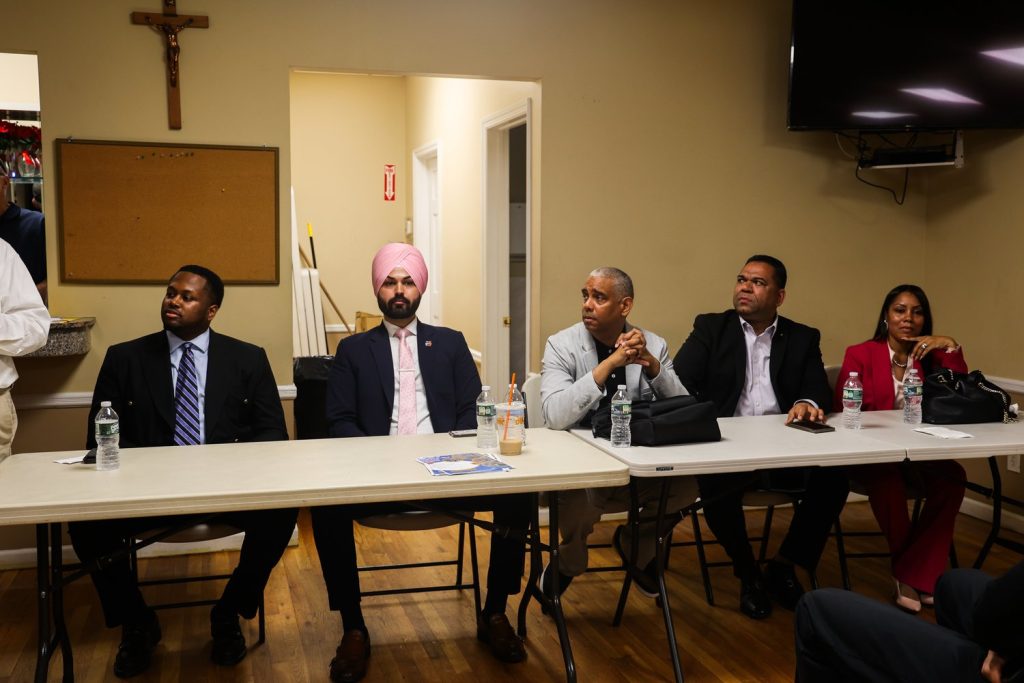
Japneet Singh and Romeo Hitlall framed their campaigns around equity and inclusion. Singh, who has raised the most campaign funds, said, “We need to make sure we have equity so all of us, collectively, can thrive, no matter what side of the Van Wyck.”
Hitlall echoed this message, highlighting how Richmond Hill and South Ozone Park “have been cut out of everything” and emphasizing his commitment to equal funding and representation.
Campaign Tensions and Challenges
Tyrell Hankerson, tied closely to Speaker Adams, faced scrutiny over whether he would serve the entire district equally, as some voters perceive Adams herself as focused mainly on the eastern neighborhoods. Hankerson defended his record, stressing his work across South Jamaica, Rochdale, and the western side.
Japneet Singh criticized Hankerson for relying heavily on Adams’ endorsement, while Latoya LeGrand emphasized the need for inclusive leadership that represents all district residents.
The Power of Rochdale Village
Political consultant Evan Stavisky highlighted the importance of Rochdale Village, located on the eastern side, as the district’s political hub. Historically, winning support there has been essential for any candidate’s success.
Stavisky noted that Adams, as Council Speaker, wields significant influence through her longstanding relationships and local presence, especially in Rochdale Village. Hankerson, her hand-picked successor, benefits from these connections and the momentum of the incumbent leadership.
Past history shows that every Council Speaker’s endorsed successor has won their race, underscoring the power of incumbency and political alliances.
Potential Shifts in Voter Turnout
While the Black community has consistently shown strong voter turnout, Stavisky pointed to a possible surge in participation among South Asian and Indo-Caribbean voters, spurred by high-profile campaigns like Jenifer Rajkumar’s run for Public Advocate and Assemblymember Zohran Mamdani’s mayoral bid.
“If there is a spike in turnout from the South Asian population as a result of Jenifer Rajkumar, that could have a significant impact on District 28,” Stavisky said.
Frequently Asked Questions
What is the significance of the Van Wyck Expressway in the District 28 City Council race?
The Van Wyck Expressway divides District 28 geographically and culturally, splitting it into two distinct communities with different political and racial identities. This divide plays a crucial role in shaping voter preferences and candidate strategies in the race.
Which neighborhoods are located on each side of the Van Wyck in District 28?
The eastern side includes South Jamaica and Rochdale, predominantly Black neighborhoods with strong voter turnout. The western side comprises Richmond Hill and South Ozone Park, known for their diverse South Asian and Indo-Caribbean populations.
How do demographics affect the District 28 race?
Black residents make up about 44% of the district’s population and traditionally have high voter turnout, giving candidates from the eastern side a strong base. South Asian and Indo-Caribbean communities, around 16% combined, are growing politically influential, especially on the western side.
Who are the main candidates representing each side of the Van Wyck?
Tyrell Hankerson, Latoya LeGrand, and Ruben Wills are from the eastern half, while Japneet Singh and Romeo Hitlall represent the western side, appealing to South Asian and Indo-Caribbean voters.
Why is representation important to voters on both sides of the Van Wyck?
Many western residents feel underrepresented by eastern-side politicians. Both communities want equitable resource allocation and political attention to address their distinct needs and concerns.
What challenges do western-side candidates face in this race?
Western candidates contend with demographic realities and historical voting patterns favoring eastern-side candidates, making it a steep climb to gain majority support.
How has redistricting impacted political representation in District 28?
Redistricting after the 2020 census has not fully addressed the political fragmentation of South Asian and Indo-Caribbean populations, who remain split across multiple council districts, diluting their voting power.
Conclusion
The Van Wyck Expressway stands as more than just a physical boundary in Queens’ District 28—it symbolizes the deep political, racial, and cultural divides that will ultimately shape the outcome of this critical City Council race. With strong candidates on both sides of the expressway representing distinct communities, the election highlights the district’s evolving demographic landscape and growing demand for equitable representation. Whichever candidate can successfully bridge these divides and earn trust across the Van Wyck will be best positioned to lead District 28 forward, ensuring all voices are heard and all neighborhoods receive the attention they deserve.