


After a four-year transformation, The Metropolitan Museum of Art has reopened the Michael C. Rockefeller Historic Wing, home to its renowned collections from Africa, the Ancient Americas, and Oceania. The reimagined 40,000-square-foot galleries showcase 1,800 artworks across five continents and countless cultures.
To mark the occasion, The Met will host a daylong festival on Saturday, May 31, featuring live music, performances, hands-on art, and more. Entry is free with museum admission, which is always pay-what-you-wish for New York residents.
Read More: Queens Chamber Honors Winners of Building Awards
Describing the renovation as a “re-envisioning,” Met CEO Max Hollein emphasized the significance of the update. New additions include never-before-seen pieces, contemporary African art, and Indigenous commissions for Oceania. A standout feature is the U.S.’s first gallery devoted to light-sensitive Andean textiles.

Enhanced visitor tools—such as films, audio guides, artist bios, and detailed wall texts—offer deeper insight and context. The redesigned space features brighter galleries, a sloped glass wall overlooking Central Park, and a striking entrance with vaulted ceilings above carved ancestor poles from West Papua.

The galleries highlight diverse stories, from Sahelian expressions of faith to Ghanian royal regalia and ancient Peruvian jewelry. The museum collaborated globally to trace each artifact’s provenance, with acquisitions sourced through private collectors, galleries, and public auctions.

Designed by WHY Architecture and Beyer Blinder Belle, with The Met’s Design Department, each gallery reflects the architectural traditions of its region. Originally opened in 1982 as Nelson Rockefeller’s personal collection, the wing continues to expand global perspectives.
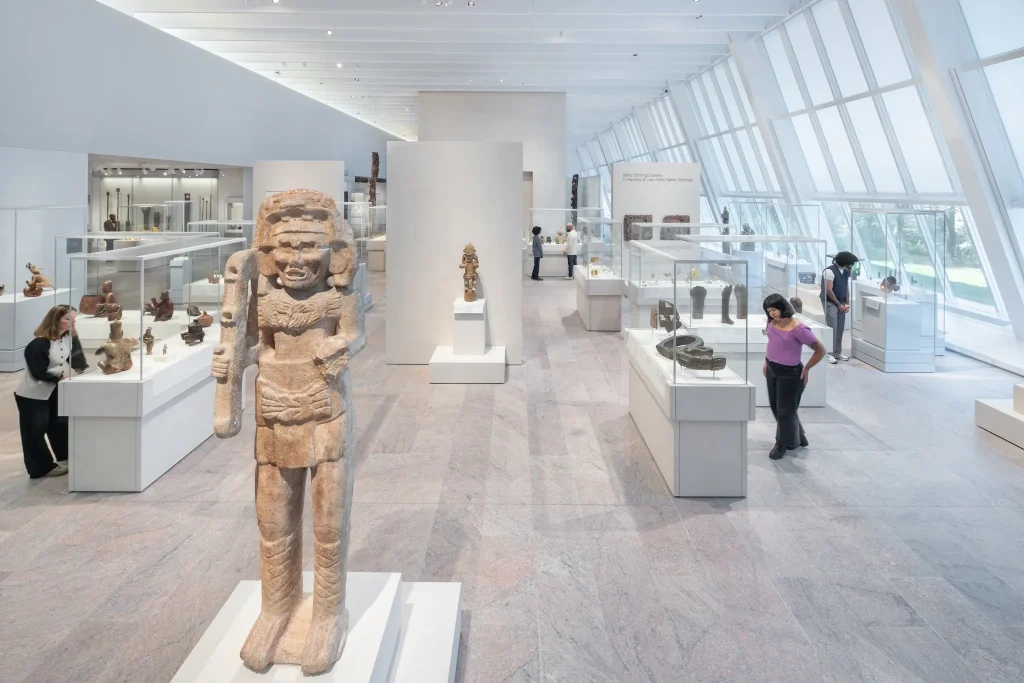
“You’ll witness human and cultural ingenuity,” said Hollein. “This is a celebration of global art and our shared connection through creativity.”
Highlights from each gallery
Arts of Africa
These galleries feature 700 works exploring the artistic legacy of Indigenous artists from across North, Central and South America and the Caribbean prior to 1600. The new galleries include monumental stone sculptures and exquisite metalwork and also include refined ceramic vessels; shimmering regalia of gold, shell, and semiprecious stone; and delicate sculptures of wood. Don’t miss the new gallery devoted to ancient American textiles and featherwork, which frames a 3,000-year history of achievements in the fiber arts.
Arts of the Ancient Americas
Discover the rich artistic legacy of Indigenous cultures from North, Central, and South America and the Caribbean in these reimagined galleries. Featuring 700 works created before 1600, the collection includes monumental stone carvings, intricate metalwork, elegant ceramic vessels, and radiant regalia made from gold, shells, and semiprecious stones. Highlights include a new gallery dedicated to ancient American textiles and featherwork, showcasing 3,000 years of innovation in fiber arts.
Arts of Oceania
Experience over 650 artworks representing 140+ distinct cultures across the Pacific Islands, Australia, and Island Southeast Asia. These newly reimagined galleries spotlight the artistic heritage of Indigenous communities, featuring monumental pieces from New Guinea and surrounding archipelagos, along with works from Australia and Southeast Asia—regions united by shared ancestry. Recent acquisitions enrich the collection with contributions by women artists, particularly fiber works by senior female creators from New Guinea and Australia, offering a more inclusive and comprehensive view of the region’s creative legacy.
Frequently Asked Questions
What wing of The Met was recently renovated?
The Michael C. Rockefeller Wing, which houses art from sub-Saharan Africa, the Ancient Americas, and Oceania, underwent a major four-year renovation.
What’s new in the updated galleries?
The galleries now feature over 1,800 works of art, including newly acquired pieces, contemporary Indigenous art, and expanded displays of textiles, metalwork, and monumental sculptures. Enhanced lighting and interpretive tools also enrich the visitor experience.
When did the updated wing reopen to the public?
The renovated Rockefeller Wing officially reopened in 2025, following an extensive redesign to modernize and recontextualize its collection.
Are there any special exhibitions or events for the reopening?
Yes, The Met is hosting a special opening celebration, including a daylong festival with live performances, music, and hands-on art activities. Check The Met’s website for the latest event schedule.
What time periods do the artworks span?
The updated galleries showcase works dating from as early as 3,000 years ago to the present day, offering a comprehensive look at cultural traditions and artistic evolution.
Are any of the artworks on view for the first time?
Yes, many pieces—including contemporary commissions and recent acquisitions—are being exhibited at The Met for the first time.
Who designed the renovation?
The renovation was led by WHY Architecture and Beyer Blinder Belle, in collaboration with The Met’s Design Department, blending modern design with cultural context.
Is the exhibit included with general admission?
Yes, access to the renovated Rockefeller Wing is included with museum admission, which remains pay-what-you-wish for New York State residents.
How does this renovation reflect The Met’s goals?
The renovation aims to present a more inclusive, global narrative by highlighting underrepresented voices and cultures, and providing deeper historical and cultural context.
Where can I learn more or plan my visit?
Visit www.metmuseum.org for ticketing, hours, exhibition details, and visitor resources.
Conclusion
The Met’s revitalized Rockefeller Wing offers a powerful reintroduction to global art traditions, bringing fresh perspective, cultural depth, and visual impact to its historic collections. With over 1,800 works spanning centuries and continents many on view for the first time the renovated galleries invite visitors to explore the creativity, resilience, and legacy of artists from Africa, the Americas, and Oceania. Thoughtfully designed spaces and enhanced interpretive tools ensure a richer, more inclusive experience, making this transformation not just an update but a celebration of human expression across time and place.